
AI Agents Need Permission Levels. Product-Data Confidence Can Provide Them.
Turn field-level product-data confidence into an access-control policy for autonomous write-back, approval, evidence gathering, and human review.
For years, enrichment systems have displayed confidence: 92% beside a generated value. The score looked reassuring. A person still checked the field, compared the source, and decided what to do.
That was the decorative era of confidence.
The number did not control anything. It was a trust signal aimed at a human who was already the control layer.
Software turns a score into a permission
An agent changes the consumer of the score. The reader is no longer a person deciding whether to believe a suggestion. It is a workflow deciding whether it may change a governed system.
A confidence score should therefore work like an access-control policy. It should grant or deny a class of action on a specific attribute.
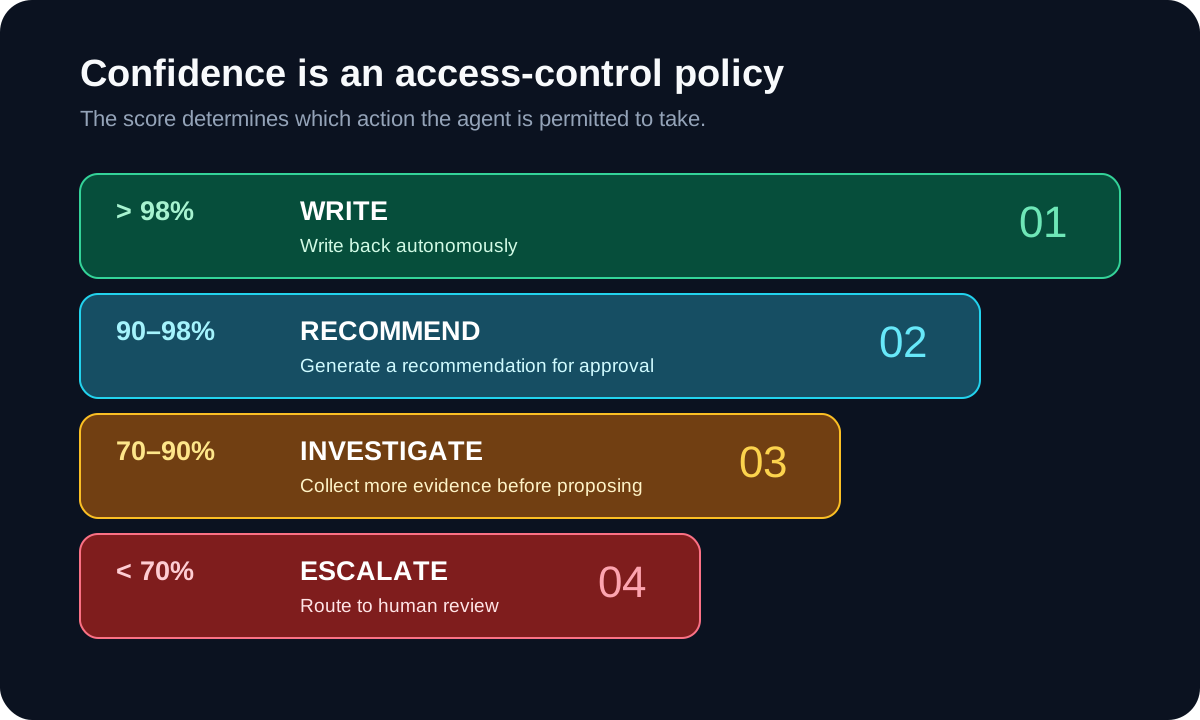
The permission ladder
Use four explicit bands:
- Above 98% — write back autonomously. The evidence, identity match, validation rules, and source authority satisfy the policy for this action.
- 90–98% — recommend for approval. The agent prepares the value and its evidence. A named owner authorizes the change.
- 70–90% — collect more evidence. The agent searches approved sources, requests a missing document, or resolves a conflict before proposing anything.
- Below 70% — route to human review. The agent stops. It presents the ambiguity without turning a weak candidate into a record.
These are starting thresholds, not universal constants. A marketing bullet and a hazardous-area rating do not deserve the same policy. The important design choice is that each band permits a different action. Confidence without a consequence is decoration.
Permission must be per field
A product record is not uniformly trustworthy.
The manufacturer may be known with 99% confidence. The packaging unit of measure may be known with 60% confidence. A record-level score averages those facts into a number that describes neither one.
That average hides the exact uncertainty that can cause an operational error. An agent could accept the manufacturer, block the packaging field, and continue gathering evidence. It cannot make that distinction when the permission attaches only to the record.
Permissions must attach to the attribute, the proposed action, and the evidence available at decision time.
Provenance carries the weight
A threshold is meaningful only when the score can be reconstructed.
For every scored value, the system must retain:
- the source and its authority;
- the source date and revision;
- the exact page, cell, response, or passage used as evidence;
- the product and variant to which the evidence applies;
- the extraction, normalization, and validation steps;
- the conflicting sources and the rule that decided between them.
Without that chain, 98% is an assertion made by the same system asking for permission. The ladder becomes theatre.
Provenance also makes review useful. A person can inspect the evidence and correct the decision, rather than repeat the agent’s research from scratch. The correction can then improve later scoring and policy.
Static confidence breaks dynamic permission
Confidence decays.
A supplier publishes a revised datasheet. A certificate expires. A product family gains a new variant. An internal validation rule changes. Evidence that justified autonomous write-back yesterday may justify review today.
The system must monitor the evidence behind the score, recompute confidence when that evidence changes, and move the permission with it. A value can be downgraded, blocked, or reopened even after approval.
Permission is a current state, not a permanent badge.
What to do Monday
Pick one write-back workflow. Choose one consequential attribute. Define the evidence required for autonomous action and set a threshold. Send everything else to approval, evidence gathering, or review.
Then measure how many fields fall below the autonomous threshold.
That number is your real automation ceiling today. It is also a precise backlog: better sources, stronger matching, clearer validation, or human decisions can raise it.
Take one manufacturer or supplier range you are onboarding today. Claro can show which products can be matched, normalized and made catalog-ready automatically, and which records still require human judgment.
Audit a supplier catalogClaro
Stop maintaining this by hand
Claro keeps product and supplier data trusted as catalogs change — matching, deduplication, enrichment, and validated write-back into the systems you already run.
Book a demo