
The Missing Execution Layer Between Supplier Data and the Agentic Enterprise
ERP owns transactions, PIM owns governed content, and agents own workflows. The missing layer turns supplier inputs into trustworthy products they can use.
The agentic enterprise has three owners and one orphan.
ERP owns transactions. PIM owns governed product content. Agents own workflows. Nobody clearly owns the work between “a supplier sent something” and “the business has a trustworthy product.”
That orphan is now the constraint on every agent above it.
Draw the stack honestly
Each established layer has a real job and a deliberate boundary.
| Layer | What it owns | What it does not claim to solve |
|---|---|---|
| ERP | Items, suppliers, purchasing, inventory, pricing, and financial transactions | Resolving contradictory supplier evidence into a canonical product |
| PIM | Governed attributes, taxonomies, approvals, channel content, and publication | Discovering what an unknown supplier row represents before governance begins |
| Agents | Planning and executing work across systems | Creating trustworthy product context from ambiguous files by assumption |
These are not product failures. ERP should remain authoritative for transactions. PIM should govern approved product information. Agents should coordinate work. The gap exists because the inputs arriving from suppliers are not yet fit for any of those jobs.
A spreadsheet names a manufacturer differently from the ERP. A PDF covers a family but not every variant. An API provides current availability and an old unit of measure. An image contains the only visible certification mark. Before downstream governance or action, those fragments must become one evidence-backed product.
The orphaned work
Between supplier input and trustworthy record sit six operational questions:
- Source: What arrived, from whom, when, and in which version?
- Resolve: Which manufacturer, product, model, and variant does it describe?
- Validate: Do values conform to the schema, rules, ranges, and other evidence?
- Decide: Which candidate wins, which action is permitted, and which exception needs a person?
- Write: Which approved value goes to ERP, PIM, ecommerce, or another target?
- Monitor: Has a source, product, rule, or confidence level changed?
This is not a one-time import. It is a continuous execution loop.
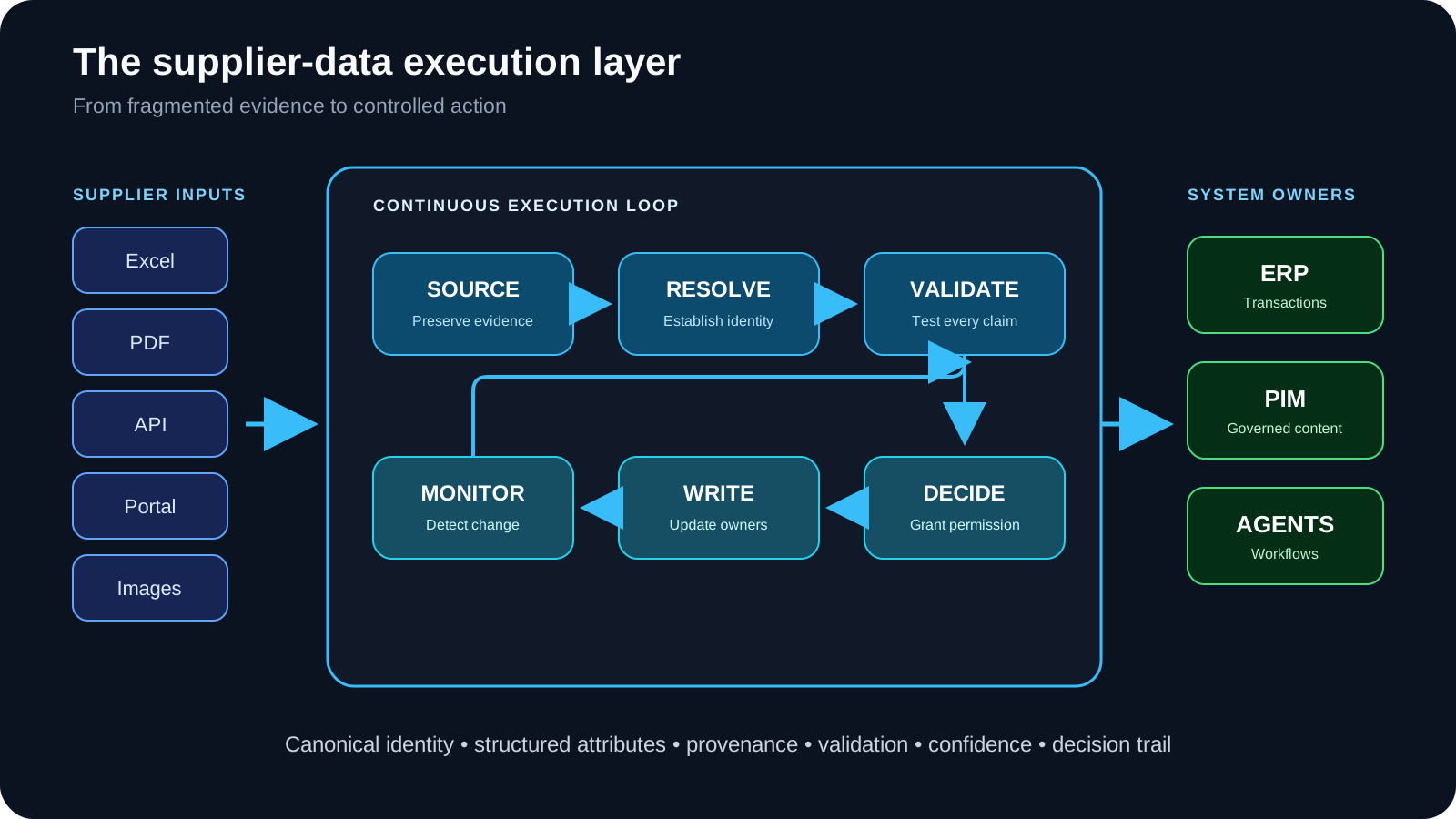
The loop defines the missing category: a supplier-data execution layer. It connects ungoverned evidence to governed systems and keeps that connection current.
Source → Resolve → Validate → Decide → Write → Monitor
Source preserves the original evidence instead of flattening it into an import row. File version, worksheet, page, endpoint, timestamp, and supplier remain attached to the values they support.
Resolve establishes canonical identity. Manufacturer aliases, supplier SKUs, GTINs, model strings, packaging levels, and variant clues become one product graph. Enrichment before identity resolution only creates richer duplicates.
Validate applies category schemas, unit rules, required attributes, plausibility checks, and cross-source conflict detection. A syntactically valid value can still be wrong for the product.
Decide turns confidence, provenance, validation, and business risk into permission. High-confidence fields may be written automatically. Ambiguous or consequential fields move to a reviewer with their evidence intact.
Write sends approved changes to the system that owns them. The execution layer does not become a shadow system of record; it makes controlled, traceable updates to ERP, PIM, and commerce platforms.
Monitor detects supplier revisions, expiring evidence, new conflicts, and downstream failures. It reopens decisions when their basis changes.
Together, the stages make product-data operations observable. A team can see where records stall, why automation stops, and which supplier or attribute creates the most exceptions.
This is not another PIM
A PIM assumes that a product can enter governance: its identity is known, its category can be assigned, and proposed values can be managed against a model. The supplier-data execution layer owns the phase before those assumptions are safe.
The distinction is simple:
PIM governs the product record. The execution layer earns the right to create or change it.
Claro does not compete with ERP or PIM. Claro is what makes their agentic future operational. It supplies the canonical identity, structured attributes, evidence, validation state, confidence, and decision trail that their agents need to act without inventing context.
Why scripts stop scaling
Teams usually encounter the gap as a file problem. A data engineer writes a parser for one supplier workbook. A PIM specialist builds a mapping. An analyst checks PDFs. A second supplier needs a second script.
The first script is cheap. Supplier scale is not.
Every source introduces its own headers, units, category language, identifiers, update cadence, and failure modes. Code handles known formats; people absorb the ambiguity. The hidden system becomes a mixture of notebooks, transformations, shared drives, email decisions, and tribal knowledge.
That approach carries six recurring costs:
- mappings are rebuilt for each supplier and category;
- evidence disappears after values are loaded;
- exceptions arrive in queues without enough context to decide;
- corrections do not become reusable policy;
- monitoring is replaced by periodic cleanup;
- scarce data teams maintain connectors instead of improving data decisions.
Building the real layer means owning identity resolution, provenance, validation, review, write-back, and monitoring as durable capabilities. The decision is not “software or no software.” It is whether to operate that system intentionally or keep paying for an accidental one.
Make the orphan visible
Start with one supplier range. Trace every step from the received source to the approved record. Mark where identity is inferred, evidence is lost, validation is manual, decisions lack ownership, and updates are not monitored.
That map reveals the actual boundary of the execution layer. It also shows why adding an agent above the current stack cannot remove the bottleneck below it.
Take one manufacturer or supplier range you are onboarding today. Claro can show which products can be matched, normalized and made catalog-ready automatically, and which records still require human judgment.
Audit a supplier catalogClaro
Stop maintaining this by hand
Claro keeps product and supplier data trusted as catalogs change — matching, deduplication, enrichment, and validated write-back into the systems you already run.
Book a demo