
Blank, Not Applicable, or Wrong: Measuring Completeness on Bearing Data
A fill-rate score treats every empty cell as a gap. On bearing data, half the blanks are correct and some filled cells are wrong. Here is how to tell them apart.
Most catalog teams track completeness as a fill rate: filled cells over total cells. On a bearing catalog that number misleads in both directions. It punishes blanks that are correct, and it rewards values that should not be there. It is the second failure point in why multi-brand bearing catalogs break.
Three states hiding behind one number
| State | Example | Right action |
|---|---|---|
| Not applicable | Seal or shield field on a 30204 tapered roller bearing, supplied open | Leave blank, exclude from the score |
| Missing, findable | Cone width B and cup width C on the same 30204, published on the maker’s datasheet | Fill from the datasheet, cite the page |
| Filled, not applicable | Radial clearance class “CN” on a 51100 thrust ball bearing | Hold for review, keep off the filters |
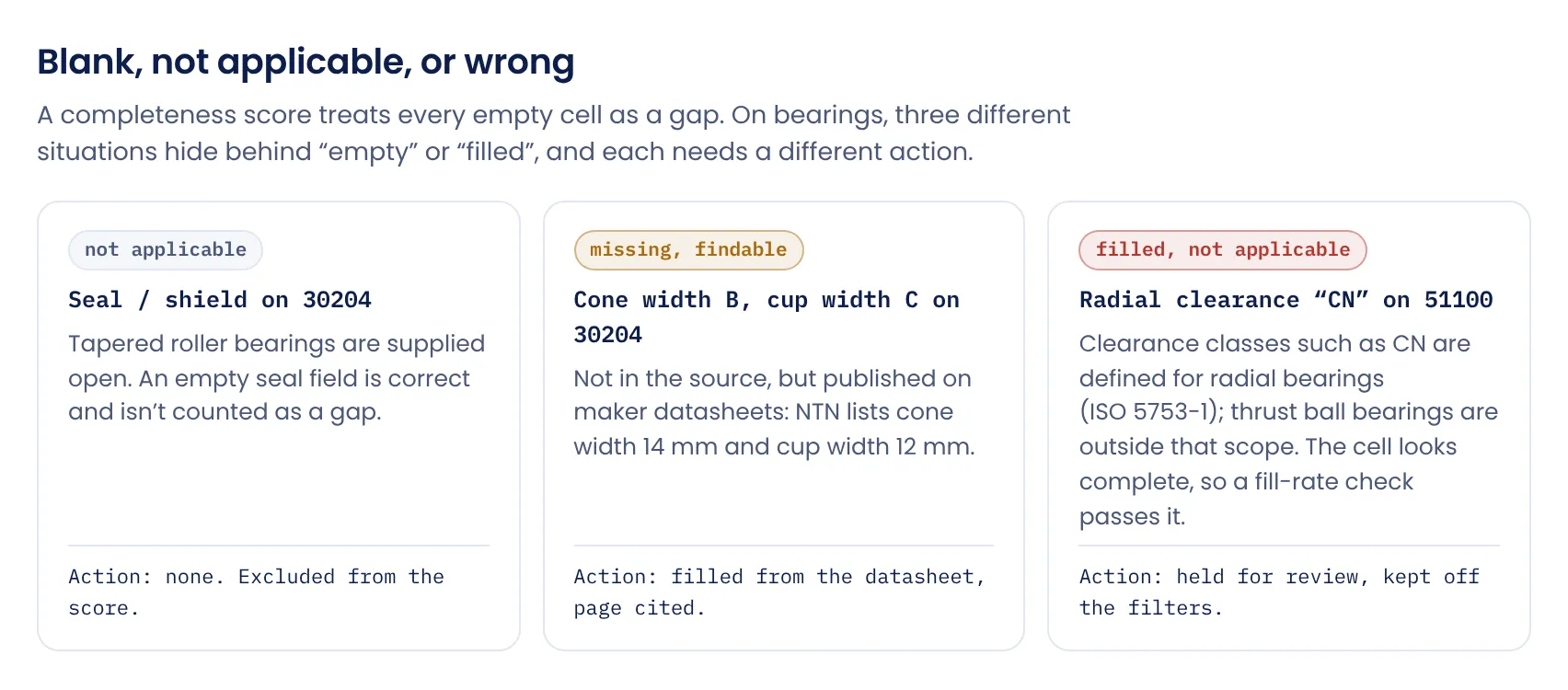
The third state is the one fill rates never catch. Radial internal clearance classes such as C2, CN and C3 are defined by ISO 5753-1 for radial bearings. Thrust ball bearings are outside its scope, so a CN on a 51100 is a value that came from a template, not from the bearing.
Why it happens
Blanks come from three places: a spec that does not exist for the bearing type, a supplier that never sent it, or a global attribute set that has no option for the right answer. Filled-but-wrong values usually come from copying one attribute set across every bearing type.
Measure completeness per bearing type
- Decide which attributes apply to each bearing type before scoring anything.
- Score completeness only against attributes that apply.
- Split the remaining gaps into findable (on a datasheet) and genuinely unknown.
- Flag values present on types where they cannot apply.
The result is a completeness number your team can act on: a list of real gaps, each with a source to fill it from. The terms used here, including radial internal clearance and “not applicable vs missing”, are defined in the bearing data glossary.
Related
Claro
Stop maintaining this by hand
Claro keeps product and supplier data trusted as catalogs change — matching, deduplication, enrichment, and validated write-back into the systems you already run.
Book a demo