
Why Multi-Brand Bearing Catalogs Break
Bearings look standardised, yet multi-brand catalogs break on dimension labels, unexplained blanks and part numbers that hide equivalent products. Here is where, and how to fix the data model.
A 6000 bearing is a 6000 bearing. Bore 10 mm, outside diameter 26 mm, width 8 mm, whoever makes it. ISO has fixed boundary dimensions for radial bearings since ISO 15, and for thrust bearings in ISO 104. So why do distributors selling SKF, FAG, NSK, NTN, Timken and their own brand end up with catalogs their customers cannot filter?
Because the standard covers the bearing, not the data about it. Every manufacturer publishes the same physical facts under its own labels, suffixes and table layouts. Each catalog is internally consistent. Put five side by side and they stop agreeing.
Three places it breaks
1. One label, several dimensions. A column called “width” holds ring width B for a deep groove ball bearing, total assembled width T for a tapered roller bearing and height H for a thrust bearing. A filter on “width = 9 mm” then puts a thrust bearing’s height next to a ball bearing’s ring width. The same happens inside one brand: a dimension lettered B on one series can be measured on a different face on the next, and only the drawing says which. The detail is in Width B, T or H.
2. Blanks nobody can explain. An empty seal field on a tapered roller bearing is correct: they are supplied open. An empty cone width on the same bearing is a real gap, and the value is on the maker’s datasheet. A radial clearance class filled in on a thrust bearing looks complete but does not apply. A fill-rate score counts all three the same way. See blank, not applicable, or wrong.
3. Equivalent parts under different numbers. SKF 6000-2RS1, NSK 6000DDU and NTN 6000LLU are the same contact-sealed bearing. A name match misses it; a loose match on dimensions alone can pair a sealed bearing with a shielded one. Before two brands can be compared on price, someone has to confirm they are the same specification. The method is in Is it the same bearing?.
What fixes it: a model before the data
The fix is not more data entry. It is an attribute model that knows what each bearing type should carry:
- Shared by every bearing: bore d, outside diameter D, mass, limiting speeds, brand part number.
- Deep groove ball bearings add ring width B, radial load ratings Cr and C0r, seal or shield type and radial clearance class.
- Tapered roller bearings add total width T, cone width B and cup width C, and have no seal field.
- Thrust ball bearings add height H and axial load ratings Ca and C0a, and carry neither seal nor radial clearance.
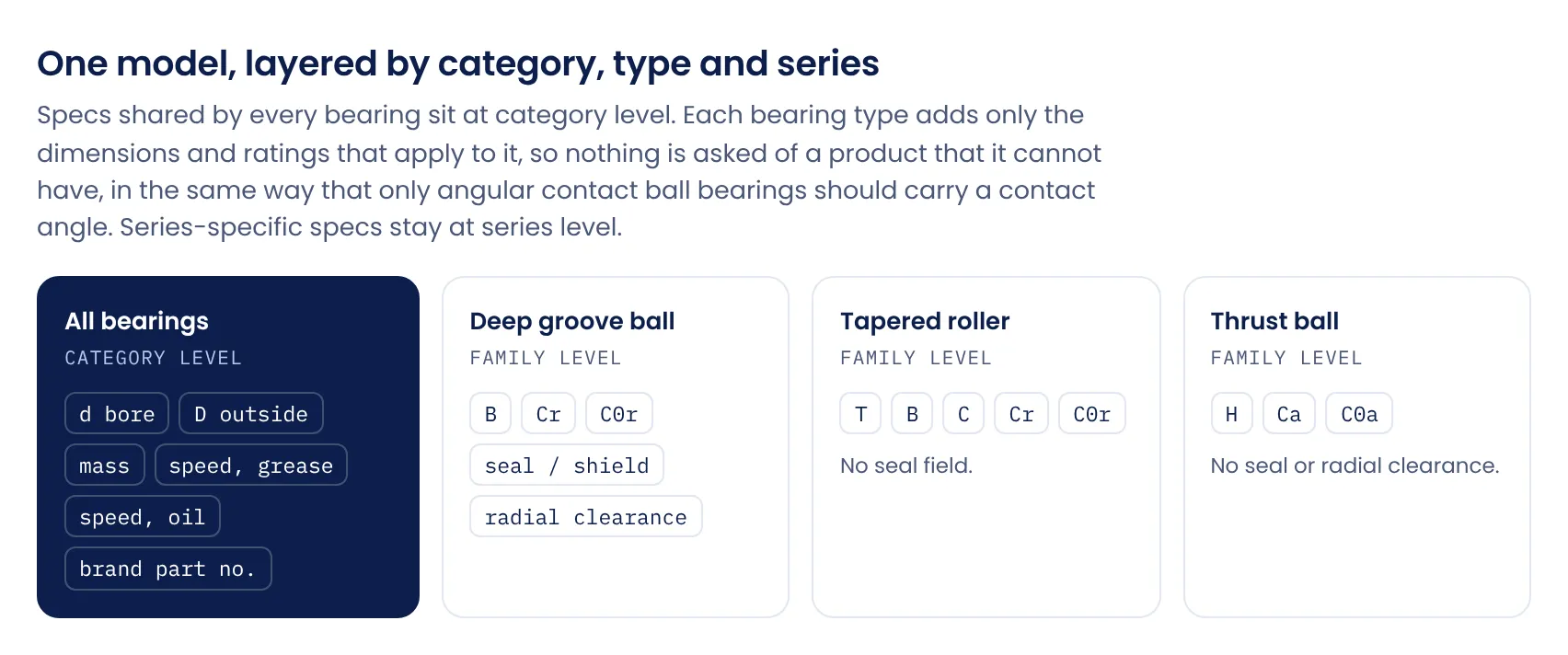
Once the model exists, every incoming value is mapped to it, every blank is classified as not applicable, missing or wrong, and every brand pairing is checked before it goes live. Each value keeps a note of where it came from. Terms such as d, D, Cr and C0a are defined in the bearing data glossary.
What the customer sees
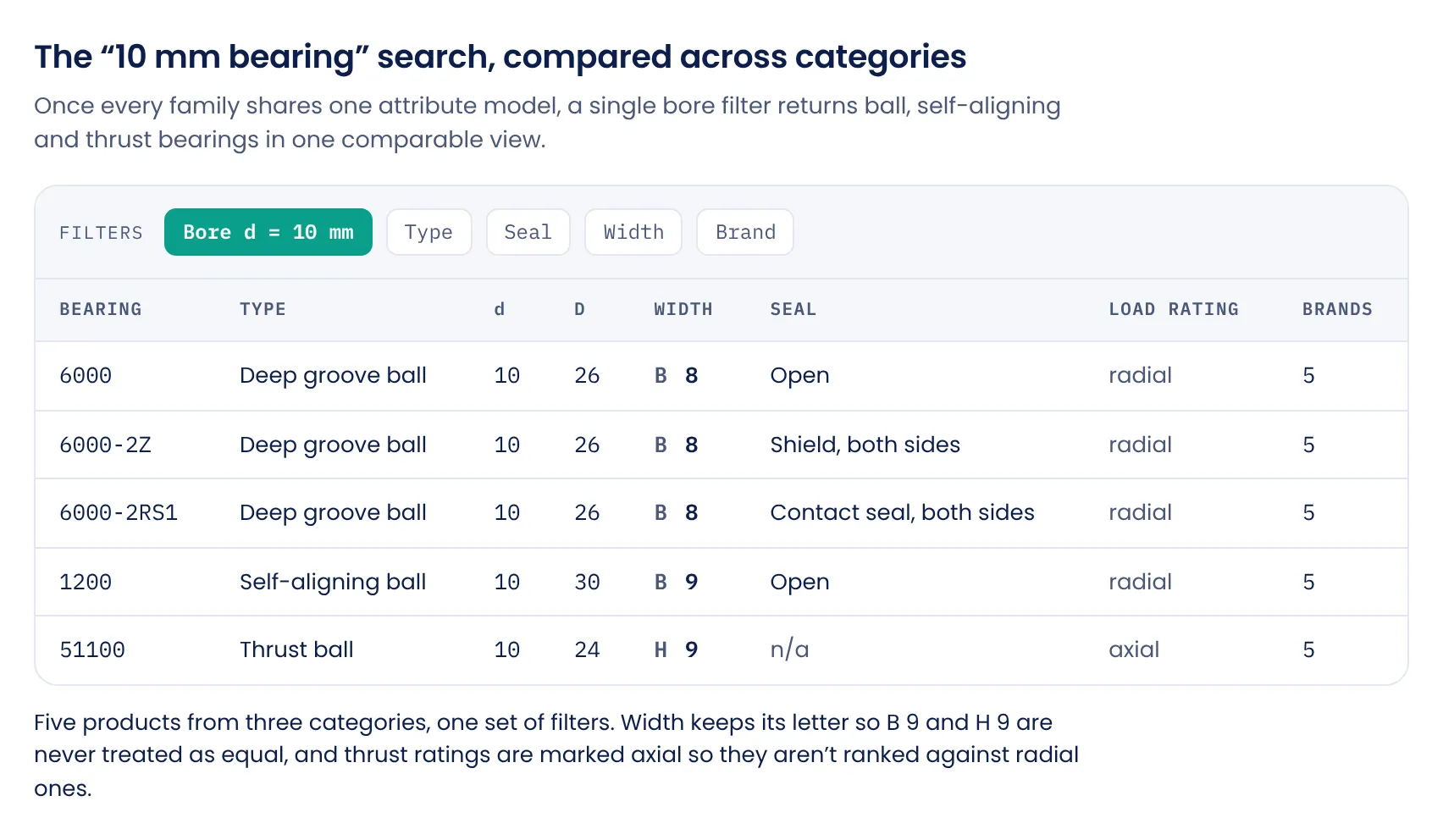
A search for a 10 mm bore returns deep groove, self-aligning and thrust bearings in one comparable view. Width keeps its letter, so B 9 and H 9 are never treated as the same thing, and thrust ratings are marked axial so they are not ranked against radial ones.
Related
Guide
Width B, T or H
The dimension labels that break your filters.
Guide
Blank, not applicable, or wrong
Measuring completeness on bearing data.
Guide
Is it the same bearing?
Cross-brand equivalence before you compare price.
Glossary
Bearing data glossary
Symbols, load ratings, clearance classes and seal codes.
Claro
Stop maintaining this by hand
Claro keeps product and supplier data trusted as catalogs change — matching, deduplication, enrichment, and validated write-back into the systems you already run.
Book a demo