
Width B, T or H: The Bearing Dimension Labels That Break Your Filters
"Width" means ring width on a ball bearing, total width on a tapered roller and height on a thrust bearing. Mixing them in one field breaks every width filter.
Ask three bearing makers for the width of a bearing and you get three different measurements, each correct for the bearing type. Put them in one catalog column and they stop being comparable. This is one of three failure points covered in why multi-brand bearing catalogs break.
Three dimensions, one column
| Bearing | Type | What “width” is | Letter | Value |
|---|---|---|---|---|
| 6000 | Deep groove ball | Ring width | B | 8 mm |
| 30204 | Tapered roller | Total width, cone and cup assembled | T | 15.25 mm |
| 51100 | Thrust ball | Bearing height | H | 9 mm |
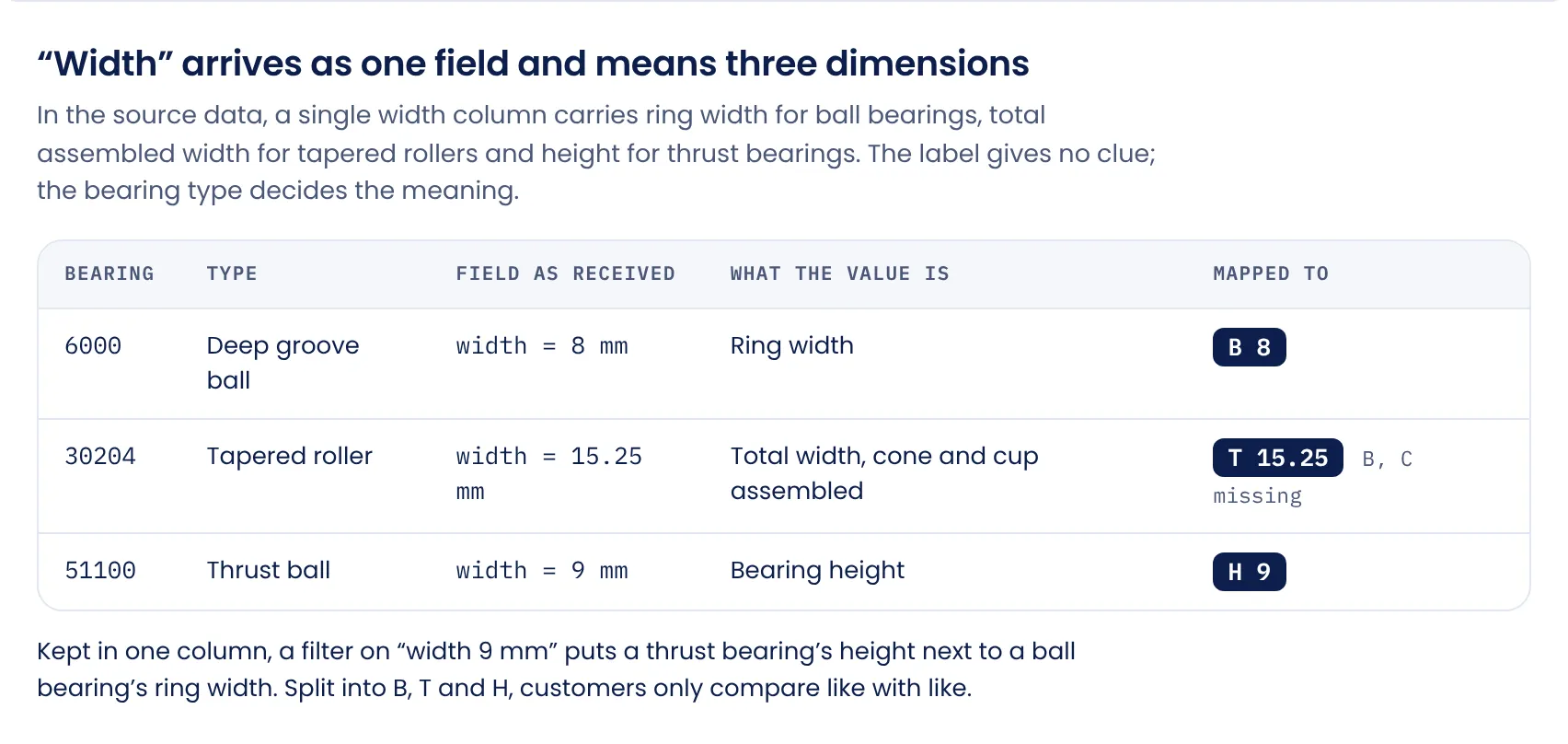
The 30204 is the clearest case. Its catalogue lists total width T = 15.25 mm, cone (inner ring) width B = 14 mm and cup (outer ring) width C = 12 mm. A feed that sends only “width” sends T. Map it to B and the product page is 1.25 mm wrong; leave B and C empty and the bearing cannot be compared with its neighbours.
The same letter, a different face
The letters do not always stay put either. Inside one manufacturer’s range, a dimension lettered B on one series can be measured on a different face on the next. Distributors that merge many brands meet this daily: the only reliable answer is the drawing, and someone has to open it.
How to fix it
- Give each bearing type its own dimension set: B for deep groove ball, T, B and C for tapered roller, H for thrust.
- Map incoming “width” fields by bearing type, not by column name.
- Fill missing dimensions from the maker’s datasheet and keep the page reference.
- Show the letter in the filter and on the product page, so a buyer never compares B 9 with H 9.
Definitions for B, T, C, H, cone and cup are in the bearing data glossary.
Related
Claro
Stop maintaining this by hand
Claro keeps product and supplier data trusted as catalogs change — matching, deduplication, enrichment, and validated write-back into the systems you already run.
Book a demo